Riptide GP2
- 4.7
- Rating
- 50.00M
- Installs
- Free
- Price
 Analysis by App-foxy
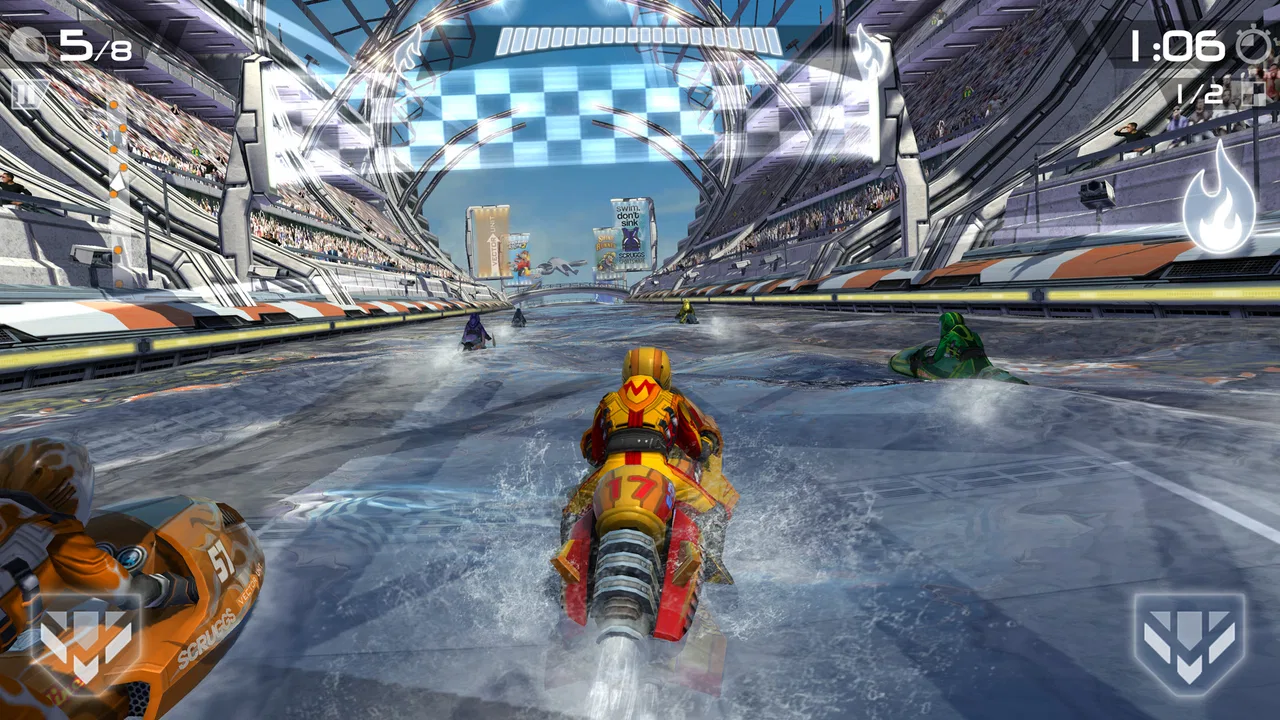
I approached Riptide GP2 as a racing game to play in short bursts rather than as a title that demands a long evening. That expectation turned out to be important. Its identity is built around high-speed watercraft, changing waves, and the need to read a course while steering through movement that never feels completely flat or predictable. I found it immediately understandable, but not effortless: the basic goal is clear, while mastering control, timing, and upgrades takes patience.
Developed by Vector Unit, this free racing game has earned a 4.6 average from around 217 thousand ratings and has passed 50 million installs. Those figures make sense after spending time with it. The game has an easy entry point, a bright presentation, and enough depth to keep a returning player interested. At the same time, its speed and visual motion can make it less comfortable for people who need a calmer, more deliberate experience.
The age rating is Everyone, and the minimum operating-system requirement is Android 7.0. The current version is 2025.09.22, so it is positioned as a broadly accessible mobile game in terms of device compatibility. I would still judge the experience by more than installation requirements. The more meaningful question is whether someone can comfortably see the track, interpret the action, and control the craft under pressure.
You May Also Like

 Blood Strike: 2.5 Anniversary
Blood Strike’s Loadouts Turn Every Drop Into a Tactical Gamble
A close look at Blood Strike’s custom loadouts: how fast access to signature weapons reshapes its battle royale rhythm, rewards preparation, and narrows the gap between fights.

 Pandora - Music & Podcasts
Pandora’s Music Is Easy to Start, but Harder to Recover
Pandora’s strength is its low-effort path from a seed to a station. Its weak spot is how much confidence it asks you to place in connection, setup, and quiet recovery.

 8 Ball Pool
 Is Built on Rivalries, Rematches, and Routine
A close look at the rivalries, rematches, shared routines, and unanswered safety questions that turn a quick pool match into a persistent mobile community.

 Samsung Music
’s Quiet Strength Is Playing What You Already Own
Its reach comes less from spectacle than from dependable access to a personal library. That simplicity is both the app’s strongest retention engine and its ceiling.

 AccuWeather: Weather Radar
AccuWeather Review: A Quick, Clear Forecast for Everyday Decisions
For everyday plans, the best forecast is the one you can understand quickly. AccuWeather makes rain timing, radar, and local conditions easy to act on, with a few trade-offs.

 Hill Climb Racing
Why Hill Climb Racing Still Turns Crashes Into One More Run
A tiny car, a bumpy hill and one more upgrade: Hill Climb Racing keeps resurfacing because its simple chaos makes every near-miss feel personal.
More From Our News Desk



How clearly the game communicates what is happening
I find the game’s clearest communication strength is that each race gives me a simple, immediate purpose, even when the screen gets busy. Learning to look toward the next stretch of water rather than fixating on the craft helps me anticipate trouble and make calmer corrections. That practical habit leads into a closer look at how the game’s fast, wave-shaped courses affect play from moment to moment.
Readable goals, busy races
One of the strongest parts of the design is that I rarely felt lost about my immediate objective. I am racing, trying to stay on the course, taking opportunities to gain speed, and learning how each stretch of water behaves. The visual language is direct enough that a new player can understand the main action without reading a long explanation first.
That clarity becomes more complicated once a race is moving quickly. Water spray, jumps, opposing racers, track edges, and changing wave shapes compete for attention. When everything lines up, the result is exciting. When the screen becomes crowded, I sometimes had to rely on anticipation instead of reacting to every detail. That is a useful distinction for players with limited visual attention: the game rewards looking ahead, but it does not always provide a quiet screen from which to do that.
The interface generally supports quick decisions rather than slow inspection. I could understand the broad state of a race at a glance, but I would not describe every moment as equally easy to parse. A smaller phone screen can make the course feel more compressed, especially when the action is fast. A larger display may help, although the game remains visually active rather than spacious.
Navigation that favors familiarity
Moving through a racing game is more than steering. Players also need to choose events, understand progression, adjust their approach, and return to a race after a mistake. I found the overall flow approachable because the game keeps bringing me back to the central activity instead of burying it under complicated menus. Someone who already understands mobile racing conventions should settle in quickly.
The trade-off is that the experience assumes a certain amount of visual confidence and gaming familiarity. I would not recommend handing it to a first-time player without allowing time to learn the controls and the meaning of the on-screen prompts. The game is not difficult to understand conceptually, but its speed leaves little room to decode everything during a race.
For a player who benefits from predictable routines, a useful approach is to repeat a familiar event before chasing better results. That turns the game into a practice loop: learn the route, identify the sections that cause trouble, and then focus on one improvement at a time. I found this less frustrating than treating every race as a test of reflexes.
What I would adjust before recommending it
Before giving it to someone who has trouble reading small interface elements, I would test it on the intended device rather than assume that every screen will feel equally comfortable. I would also play with the device held in the position that feels most stable, because a control setup that is technically usable can still be tiring if the hands are constantly shifting.
I would avoid starting with a noisy environment. The visual action already asks for concentration, and interruptions make it harder to maintain a sense of where the craft is heading. In a quiet room, the same race feels more manageable because I can watch the course rather than divide attention between the game and surrounding activity.
Controls, timing, and physical effort
The central physical challenge is maintaining control while the watercraft moves quickly across uneven-looking surfaces and airborne sections. I found that small corrections matter more than dramatic movements. Oversteering can turn a recoverable line into a missed section, while a delayed correction may leave too little space to respond.
This makes the game appealing to players who enjoy reflex-based racing, but it also creates a barrier for anyone with limited fine motor control, hand fatigue, tremor, or difficulty holding a device steadily. A short session may be comfortable, while repeated attempts at the same demanding section can become tiring. The game is most welcoming when the player can make controlled, repeatable inputs without pain or strain.
One practical tip is to treat the first attempts as route-reading sessions. Instead of trying to win immediately, I watch where the course asks for a turn, a jump, or a correction. That reduces unnecessary frantic input. It is a small change, but it makes the game feel less like a test of constant reaction and more like a test of timing.
Why the waves change the control experience
The water is not merely decoration. It gives the races their character and changes how I judge movement. A flat road racer can often be read as a clean line from one corner to the next. Here, the surface and jumps make the craft feel more alive, which is exciting but less predictable for a player who prefers stable visual references.
That difference matters for sensory comfort. Rapid motion, bright scenery, and repeated jumps may be enjoyable for one person and tiring for another. I would be cautious about recommending long sessions to someone who is sensitive to motion or visual intensity. The safest way to judge it is to begin with a brief play period and notice whether the action remains comfortable after the novelty wears off.
I also found that the game rewards looking beyond the craft itself. Watching only the vehicle makes it easy to react too late. Looking toward the next section of water gives more time to prepare. This is one of the most useful habits for players who find fast action overwhelming: shift attention from the immediate effects to the upcoming route.
Sound, focus, and sensory load
Racing games often use movement, engine noise, music, and visual effects together to create momentum. In this case, the result supports the feeling of speed, but it can also raise the overall sensory load. Players who prefer a quiet environment may want to control their surroundings before starting rather than expecting the game itself to feel minimal.
I would not make sound essential to understanding the main race. The important information is visible, so someone who plays with the audio reduced can still engage with the core activity. That can be useful during travel, in a shared room, or whenever sound is distracting. The game remains more demanding visually, however, so reducing audio does not turn it into a low-stimulation experience.
A realistic everyday use case is a short break between tasks. I can play one race while waiting for an appointment or during a pause at home, then stop before the session becomes tiring. That works better for me than playing while commuting on foot, standing in a crowded vehicle, or dealing with frequent interruptions. The game needs enough visual attention that unstable surroundings quickly reduce enjoyment.
Playing in different environments
As a free game, it is easy to try without making an immediate purchase decision. That makes it suitable for sharing with family members or friends who want to compare a few mobile racing experiences. The Everyone rating also makes it a more comfortable recommendation for mixed-age households, although the physical intensity of play still varies from person to person.
It is less suitable when the player needs a game that can be followed casually while multitasking. I could pause my attention for a menu or a loading transition, but not during a demanding section of a race. If someone wants a title that can sit in the background while they listen to a podcast, this is probably the wrong kind of racing game.
Device choice affects the experience more than I initially expected. A stable grip, a screen that makes the track easy to inspect, and enough battery for the intended session all matter. The minimum operating-system requirement is Android 7.0, but compatibility alone does not guarantee comfort. I would test responsiveness and visibility on the actual phone rather than relying only on the age of the software.
Where it stands beside other mobile racers
Compared with simpler arcade racers, this game asks more from the player because the watercraft and waves make each course less predictable. That gives it a stronger sense of personality than a basic steering-and-accelerating game. I enjoyed the feeling that success came from learning the shape of a race, not just holding a direction and waiting for the finish.
Compared with more simulation-focused racing games, it is easier to approach. I do not need to understand real vehicle handling to enjoy a run. The emphasis is on speed, timing, and spectacle rather than careful mechanical realism. That makes it a good middle ground for players who want more involvement than an automatic racer but less seriousness than a detailed driving simulator.
There is also a meaningful difference from slower puzzle-racing or turn-based alternatives. Those games give the player time to inspect a situation and plan. This one asks for decisions while the course is moving toward me. If accessibility for a particular player means having unlimited time to process information, a slower alternative may be a better fit even if its graphics are less impressive.
Progression, spending, and patience
The game is free to download, with in-app purchases ranging from $1.99 to $99.99 per item. That is important context for anyone choosing it for a child or for a shared device. I would approach the purchase system deliberately, especially if the player is likely to chase progress when a difficult event becomes frustrating.
My advice is to decide in advance whether spending belongs in the experience. The racing itself should be evaluated first, because no purchase changes the fact that the player still needs to read the course and control the craft. If someone dislikes optional spending in free-to-play games, that alone may be a reason to choose a paid racing title instead.
The bigger trade-off is not simply cost. It is patience. Players who enjoy repeating an event, learning a route, and gradually improving will find more value here than players who expect every attempt to feel immediately successful. I prefer the former approach, but I can see why someone seeking a completely relaxed game might stop after a few difficult runs.
Who benefits most from this design
I would recommend it to someone who wants a visually energetic racing game that works in short sessions but still gives room to improve. It is especially suitable for players who enjoy mastering routes, making small control corrections, and comparing their own performance across repeated attempts.
It can also work well for a family member who already plays arcade racers and wants something with a different physical setting. The watercraft give the game a distinct feel without requiring the player to learn a complicated simulation. A friend who likes speed but dislikes realistic car handling may find this more inviting than a conventional road racer.
I would be more cautious with players who experience discomfort from rapid movement, have difficulty with precise touch control, or need a low-pressure game that can be played while distracted. I would also skip it for someone who strongly prefers offline-feeling, one-time-purchase experiences and does not want to think about in-app purchases. Those are not minor preferences; they affect whether the game feels welcoming.
Remaining barriers I noticed
The largest barrier is the combination of speed and visual density. The game communicates its purpose clearly, but clarity does not mean low effort. A player may understand exactly what to do and still struggle to do it comfortably. That distinction is easy to miss when judging a game only by its menus or store description.
Another barrier is the physical demand of repeated corrections. A player with strong control can make the action look effortless, while someone with limited dexterity may need more time and may tire sooner. I found that route familiarity helps, but it does not remove the need for timely input.
The game also depends on a suitable context. A bright, stable screen and a quiet place make a noticeable difference. Playing during movement, under glare, or with constant interruptions turns a lively race into a frustrating one. For inclusive use, the surrounding situation matters almost as much as the software.
Finally, the free-to-play structure deserves honest consideration. The download price is zero, but the listed purchase range means families should make their own boundaries clear. That is particularly relevant when the game is shared with younger players, even though its content rating is Everyone.
My inclusive verdict
After playing it with these different situations in mind, I see Riptide GP2 as an approachable but physically and visually active racing game. It does a good job of explaining its central appeal through the races themselves: fast watercraft, changing waves, and a clear push toward better timing. I never needed a complicated explanation to understand why a run succeeded or failed.
Its inclusive strengths are its broad device requirement, simple core premise, free entry, and ability to support short practice sessions. Its limitations are equally clear: fast motion, busy scenes, precise control, and a purchase model that may not suit every household. There is no single setting that makes those trade-offs disappear, so the best recommendation depends on the player’s comfort rather than the rating alone.
If I were recommending it to a friend, I would say to try it in a calm environment, begin with short sessions, and focus on learning the route before chasing perfect results. I would also check whether the screen and controls feel comfortable after several minutes, not just during the first exciting race. For players who enjoy energetic arcade racing and can manage its sensory and motor demands, it is a strong choice. For anyone needing slower pacing, minimal stimulation, or completely predictable control, a gentler racing alternative will be the better fit.
FAQs for Riptide GP2
01What platforms is Riptide GP2 available on?
Riptide GP2 is available on both Android and iOS platforms. It offers a seamless experience across smartphones and tablets, allowing users to enjoy the game on their preferred device. The game is also available on other platforms like Windows and consoles, expanding its accessibility to a wider audience.
02What are the main features of Riptide GP2?
Riptide GP2 features stunning graphics, realistic water physics, and challenging courses that engage players. It includes a career mode, online multiplayer, and customizable hydro jets. Players can perform stunts and unlock new vehicles, adding depth and replayability to the game. The intuitive controls enhance the overall gaming experience.
03Does Riptide GP2 require an internet connection to play?
Riptide GP2 can be played offline in its career mode, allowing players to enjoy the game without an internet connection. However, for multiplayer races and to access leaderboards, an internet connection is necessary. This flexibility ensures that users can enjoy the game both online and offline.
04Are there in-app purchases in Riptide GP2?
Yes, Riptide GP2 includes in-app purchases that allow players to buy in-game currency and unlock certain features or upgrades more quickly. While these purchases can enhance the gaming experience, they are entirely optional, and players can enjoy the full game without spending additional money.
05What age group is Riptide GP2 suitable for?
Riptide GP2 is suitable for players aged 10 and above. The game features fast-paced racing with mild competitive elements, making it ideal for both younger players and adults. Its exciting gameplay, combined with simple controls, ensures that it appeals to a broad audience, providing fun for all ages.
Pros
- Stunning graphics and realistic water physics.
- Intuitive controls enhance gameplay experience.
- Wide variety of customizable jet skis.
- Multiplayer mode for competitive racing.
- Frequent updates keep the game fresh.
Cons
- Requires internet for multiplayer mode.
- In-app purchases can be expensive.
- Occasional lag on older devices.
- Limited track variety can become repetitive.
- Battery drain is noticeable during long play.

Riptide GP2
Gallery